

In 1991, Mark Weiser wrote “the most profound technologies are those that disappear. They weave themselves into the fabric of everyday life until they are indistinguishable from it.”
Weiser was CTO at Xerox Parc, the infamous research lab that gave birth to many of the modern computing inventions like the desktop, the mouse, the GUI, among many many more. In this essay, he presented “ubiquitous computing,” a vision of technology with computers embedded into all of our daily objects rather than stuck in powerful desktops. A core part of the idea was idea of pads, a small handheld, “scrap computer,” which should be treated like scrap paper.1
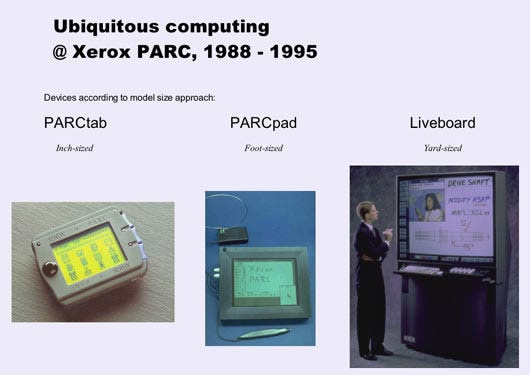
This idea of “scrap computers” stuck with me, and I found myself reflecting what makes something disposable. What makes disposable software? How do you practice disposable making?
I like the term because it sounds like an insult. It dares you to engage with something rough on the edges and easily dismissed. But it also gives you permission to follow your gut because there’s no pressure to show something good.
My natural instinct is to explore via quantity: making a lot of stuff around a theme, fumbling my way to something of meaning. I’m not built to polish one final artifact. I keep fighting my natural instinct because polish is what gets rewarded, but what if I leaned into what I’m good at?
On my birthday in 2021, I started a challenge to write 100 mini-essays by the end of the year. It began as a gambit to myself—can I even make 100 things if I commit to it? The start was slow and hard as all starts are. I gnawed and railed against the commitment, forcing myself to sit down and setting timers to make sure I didn’t spend too long on any individual piece. Then, after a few times, a surprising ease settles in. It’s still hard every once in a while when I get stuck, but overall, it’s smooth, almost natural. Some pieces were certainly meh if not bad. Others felt like striking gold but only digging so far to see a glimpse of it above the dirt, like a golden iceberg rising out of the ground. Most of all, the process helped me understand the kind of writer I was.
In the end, I wrote 50,000+ words by the end of 2021, about the size of an average non-fiction book. (this is the first time I’ve compared it to a book and wow, it really feels shocking to make that realization).
This kind of daily making isn’t foreign to art making or even software art making. It’s a common constraint in drawing classes to do timed drawings, one-minute, five-minute, and so on. Zach Lieberman, an established code artist, recently opened a show showcasing 10 years of practicing daily sketches.
These things are all disposable—cheap, easily replaceable or take limited time but still very much valuable. They are intentional and taken in aggregate, meaningful and impressive.
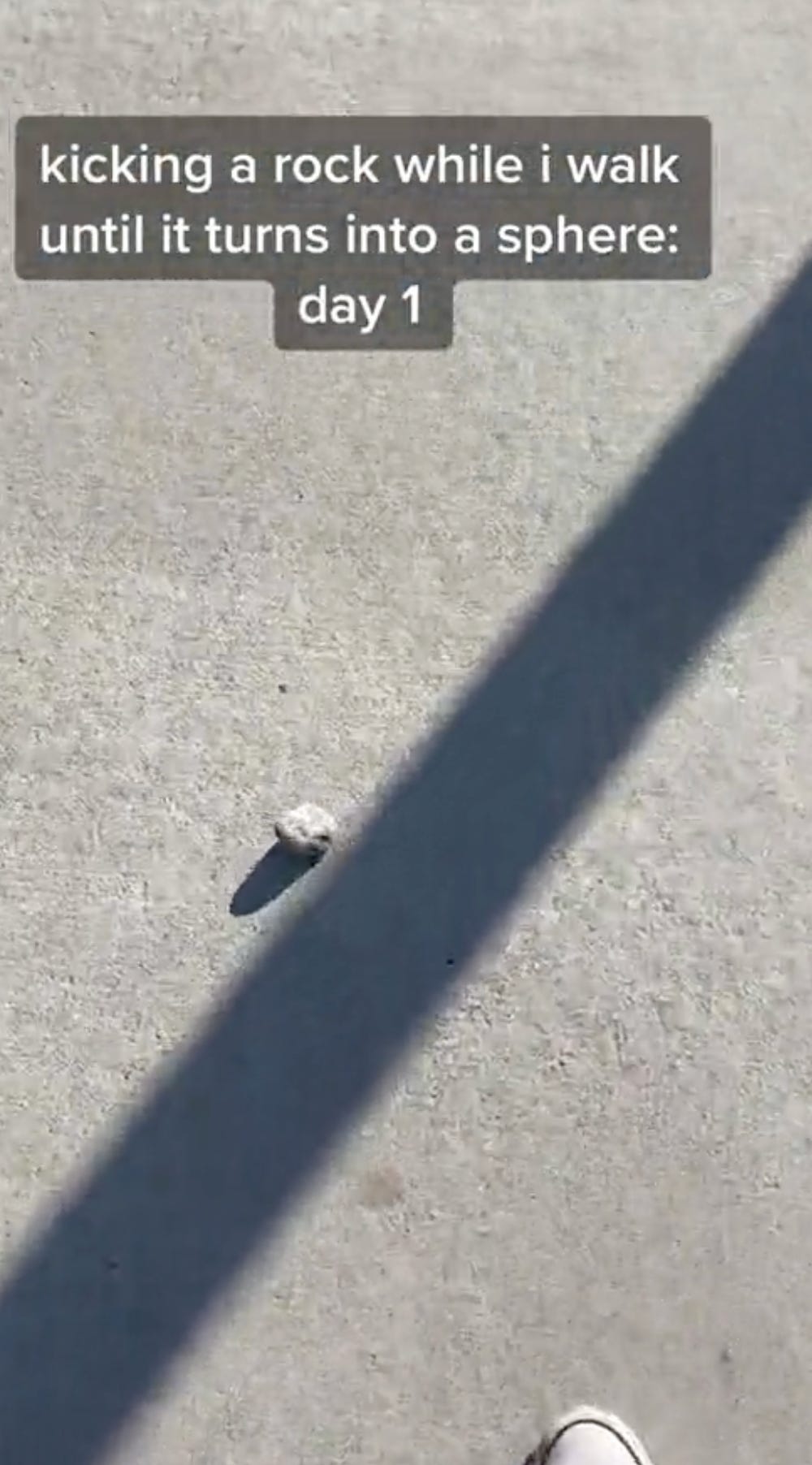
Even things that are simple and “dumb” on the surface, become poetic when you commit to them long enough. I’ve been obsessed with finding and following the most insane examples of the “day x of y” videos on social media. For example, kicking a rock until it’s a sphere for hundreds of days, finding the crunchiest leaf, spinning loaves of bread, dropping a hydroflask, even fermenting kimchi at a Dave & Busters (h/t Danielle).2
There’s a freedom in the simple constraints. Your mind learns what can it be on autopilot for and starts discover creative angles in the repetition.
With the rise of LLMs and “vibe coding,” more and more essays and software are disposable in a different way. They have little to no lasting value and many are designed to “trick you” to capture your attention. They are empty.
It feels like walking into an abandoned mall: all the bones and none of the life.
These things are both disposable, but one is scrap—quick & intuitive but intentional—and the other is trash—mindlessly created en-masse.
What separates meaningful disposable work from empty work?
It’s not time invested or amount of flourish or even the end impact of it.
The value comes from the story, the intention, the lore behind the practice. The world around the work is what gives it soul. The meaning comes from the process and the commitment.
It’s the same thing that separates all the tech words that we’ve lost (community, agency, taste) from the real thing.
You know it when you see it. What’s real feels intimate, honest, true.
I’m thinking about all the daily practices I’ve tried in the past: creating experiments for playhtml, posting videos talking to the camera, & doing something physical with my hands.
I stopped doing this as much in public because I’ve become more self-conscious about what I share as my following has grown. I feel pressure to make my content worth it for people to consume and worry about attracting haters. I keep trying to remind myself that making people feel something is better than making them feel nothing, and receiving strong responses is what it means to make meaningful art.
I’d like to return to these humble, primitive roots, to share works-in-progress, experiments that become obsolete, and potential failures.
Today’s media economy also rewards continuous output. Attention decays fast. The momentum of continuously putting things out carries an unstoppable quality. Scrap works have a certain lightness to them that allows you to play, and the continual practice (and virtuous cycle of improvement) makes it feel like it produces perpetual energy.
Some artists would like to be inscrutable, but I’ve never understood that perspective. I’m reminding myself that my work is an attempt to connect with others—to feel deeply understood through my creations. I want the things I make to feel like one big accumulation of the same ideas.
I’ve been reading Brian Eno’s diary, A Year of Swollen Appendices, and at the beginning of the year, he recalls an old saying, “Old ideas don’t go away - new ones just get added.” Three years into exploring my own ideas full-time, I find it to be true. These days I’m still working on making a more lived-in, alive internet (in a new evolution of a project I started four years ago), inventing more playful ways to weird our ubiquitous devices, and discovering the joys of new ways of seeing, through materials, crafts, and structures.
I can’t wait to make again tomorrow.
In the spirit of disposable making, I’m going to be turning this section of my newsletter back into its original spirit of lab notes. It should be regular, easy (not so edited), and most of all, honest. Hope they make you feel more welcome to chime in :)
Updates
I’m making Internet portraits out of my cursor movements, keypresses, scrolls, etc. I’m anonymously collecting this data from others to create a collective portrait, and I’d be honored to have your data contribute. Eventually, the hope is for this to turn the entire internet into a shared, living social space that changes with our actual use and presence on websites. Sign up on wewere.online
I just released an easter egg on my website that shows people when I’m home and launches a live chat. I’d like to host an online studio visit at some point in the next couple of weeks. If you’re interested, just reply and I’ll tell you the details! I’ll also post on my socials about this at some point
I have a couple of shows coming up! On May 2nd-July in Miami some of my cursor trail work will be shown at What’s My Line and I’ll be debuting an embodied cousin of the cursor work at All Street Gallery for Recalculating Route.
what i’m paying attention to
or a short poem made from my recent are.na blocks
chopsticks makers, NASA artist-in-residence spelling with the earth, crickets in public toilets (h/t riley), keyboard sculpture, bespoke tv show video games for social media, artists that do it for the love of the game, the depths of cursed technology, it’s selfish to be an artist but if you do it, believe in something.
(I’m experimenting with this new form—perhaps another daily disposable making practice… pls let me know if you enjoy, but i enjoyed just doing this in 5 mins so i think i will keep doing it..)
This dispatch was sent to 2274 inboxes. My writing is always free and open, but I am independently funded and appreciate any support you can offer. Consider sharing this with a friend and becoming a patron (or for those without Github, subscribing on Substack) for the warm & fuzzy feeling of supporting an indie artist (and access to the community & works-in-progress).
Thank you to the 30 people who supported my independent work with a sponsorship last month, and a warm welcome to Mara, Tyrone, and Kendall.
Robin Sloan, a wonderful author and experimental technologist, is playing with some wonderful “paper computers.” The initial public experiment of which is a Magic Postcard. I’m excited to watch where he takes this :)
“Doing X for every new follower I gain” is the new evolution of this trend that mostly removes the poetic qualities I appreciate because they are optimized for growing big followings and remove the humble daily practice.