

My first memories of being on the computer and the internet involved playing video games with friends and strangers, collaborating, competing, discovering the edges of what relationships with other people could be.
It’s probably why I’ve always gravitated towards play and joy in my work.
These games provided a setting for discovering what I valued, masked behind a fun objective. At some points I lost sight of the fun, dragged into grinds for achievement, but I remember feeling the most free and lucid in the moments I was immersed in the play—discovering new ways of doing this from first principles, seeing how people can make something seemingly impossible happen, being surprised by the kindness and meanness of others.
I imagine its how mathematicians feel when discovering a new proof. A satisfying click as ideas, observations, and hunches align in your mind. The mess, all at once, becoming clear.
It somehow feels easier when you’re having fun. Or maybe you’re just more open to receiving the answer from the universe.
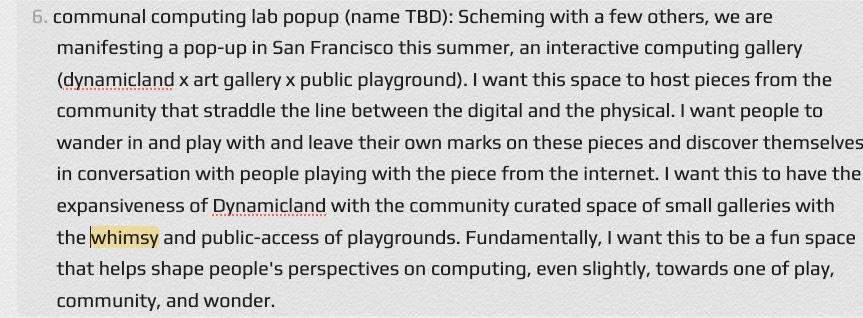
Whimsy is on the cultural rise. People are whimsymaxxing, saving viral carousels about whimsical parts of the web, and finding new ways to find whimsy. It’s weird that it’s becoming profitable for your clout to care about whimsy, but it’s not surprising that it’s finding widespread resonance.
While the world goes through more wars, gambling platforms profit on them, and we see the largest concentration of wealth unfolding, the absurdity of being whimsical in the face of these things feels like the only rational response. These silly, joyful acts are survival mechanisms. But they also contain the seed of resistance.
Play demands an openness to new possibilities: combinations that wouldn’t normally make sense and potentials that seemingly defy logic. Whimsy invites the unpredictable: taking something known and turning it on its head to become something entirely new. It invites others to make their own versions. Rather than consolidating power, it distributes the power of imagination.
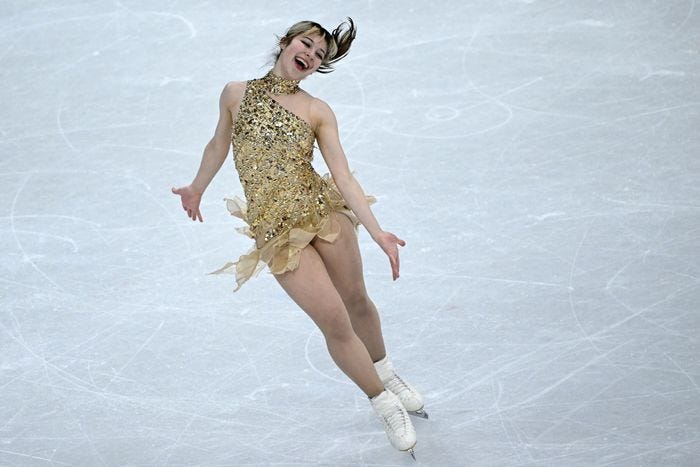
Alysa Liu became the most recognized example of this philosophy in action towards performance after she won an Olympic gold medal with a story about burnout and returning after finding the love of the game.
“Only gradually did I begin to see them as twin emanations from a single source, his social ease as grounded in his self-sufficiency, his anarchic whimsy as contained by his fierce sense of discipline and integrity.”
—on Robert Irwin from Seeing is Forgetting the Name of the Thing One Sees.
Serious play combines the dedication of hard work with the lightness of expectation-free fun. It’s difficult to strike the balance, but when you do, it feels like running through air. Like everything unfocused suddenly snaps into sharpness. A widening of aperture allows more light in and suddenly the world looks entirely different. You become open to new ways of seeing and each new method becomes a new angle on your worldview, a merging kaleidoscope of perspectives.
If whimsy is on one extreme, critique is on the other.
Critique has always been in fashion since the start of the 2000s. The world has gone through crisis after crisis, and people (rightfully) voiced what went wrong and are weary of putting their trust in something that gives out on them again.
I don’t have a problem with good critique—it’s needed to make things tangibly better, but it has severe limitations. Critique must anchor itself to the status quo, and often, it can veer into punching down and shaming others for trying something new.
In a world of critique, there is little room to try new things. Most are starved and killed off, so the only way they become real is through the lucky, determined, delusional few who power through and grow to believe that they are chosen.
Meanwhile, play leaves you free to imagine what else could be. It has the power to radicalize in the way that critique can’t through new positive imaginations.
Zohran Mamdani rides this wave. Joy underlies all of his messages and is what fueled the promises that seemed impossible on the campaign trail. In 1978, Audre Lorde championed the sharing of joy as a necessary catalyst for radical change, but we had lost the will to fight for it until recently.

The effect spreads exponentially, like ripples in a pond. A child grows up believing they can propose their own policies. A neighbor rallies people to fix longstanding issues. An artist decides to stay and fight for the livability of their community rather than moving out. Beyond every individual change, joyful visions break down the barriers for what people give themselves permission to do.
Play shapes culture so that anyone can be a dreamer, too.
So what do I seek with my whimsy?
I fight for a joyful vision of technology and the internet. I believe that everything we take for granted today about our technological landscape—massive power imbalance, closed platforms and ecosystems, an over-capitalized environment—can be changed. I think the internet can be filled with millions of tiny internets, expressive and communal, that give us new surface areas for fostering close bonds, encountering new people, and forming a deeper belief in the shared humanity of our race. We’ll invent new devices that invite new ways for using them together, rather than being alone in our own worlds. We’ll create algorithms that optimize for exposing us to new ideas, bringing us into contact with those with unexpected similarities, and help us fight against slop and spam. Digital material will be as easy to shape and make as it is for anyone to write—just another medium for us to make our journey through this thing we call life more free, joyful, and fulfilled.
Let’s dare to dream again. Allow ourselves to be a little crazy. Embrace the unpredictability of creative whimsy. Dance with the impossible.
(If you liked this, you’ll probably enjoy the essay I wrote about digital playgrounds and distinguishing play from its common misuse as gamification)
Recent Updates
I’m in the Boston airport, heading back to SF after a whirlwind one-day trip to Maine to speak and perform in a upcoming documentary about computers. I talked about my vision in front of a dancer who identified as a tech minimalist yet told me how my words sparked some hope for technology that she had long lost. What an honor it is to advocate for a different way that our devices could support us.What a joy it is to be alive!
Social experiments are coming to we were online: leave letters for websites, share browsing activity with friends, and stumble upon new areas. Install it and send me any feedback! You can also join the discord and give feedback on some of the things in store.
I’m looking for an assistant / apprentice / intern to help me with my various projects! Best for someone technical, creative, or who loves telling stories, wants to grow in all those areas, and cares about this kind of technology work. Share with anyone who might fit :) https://spencer.place/help-2026/
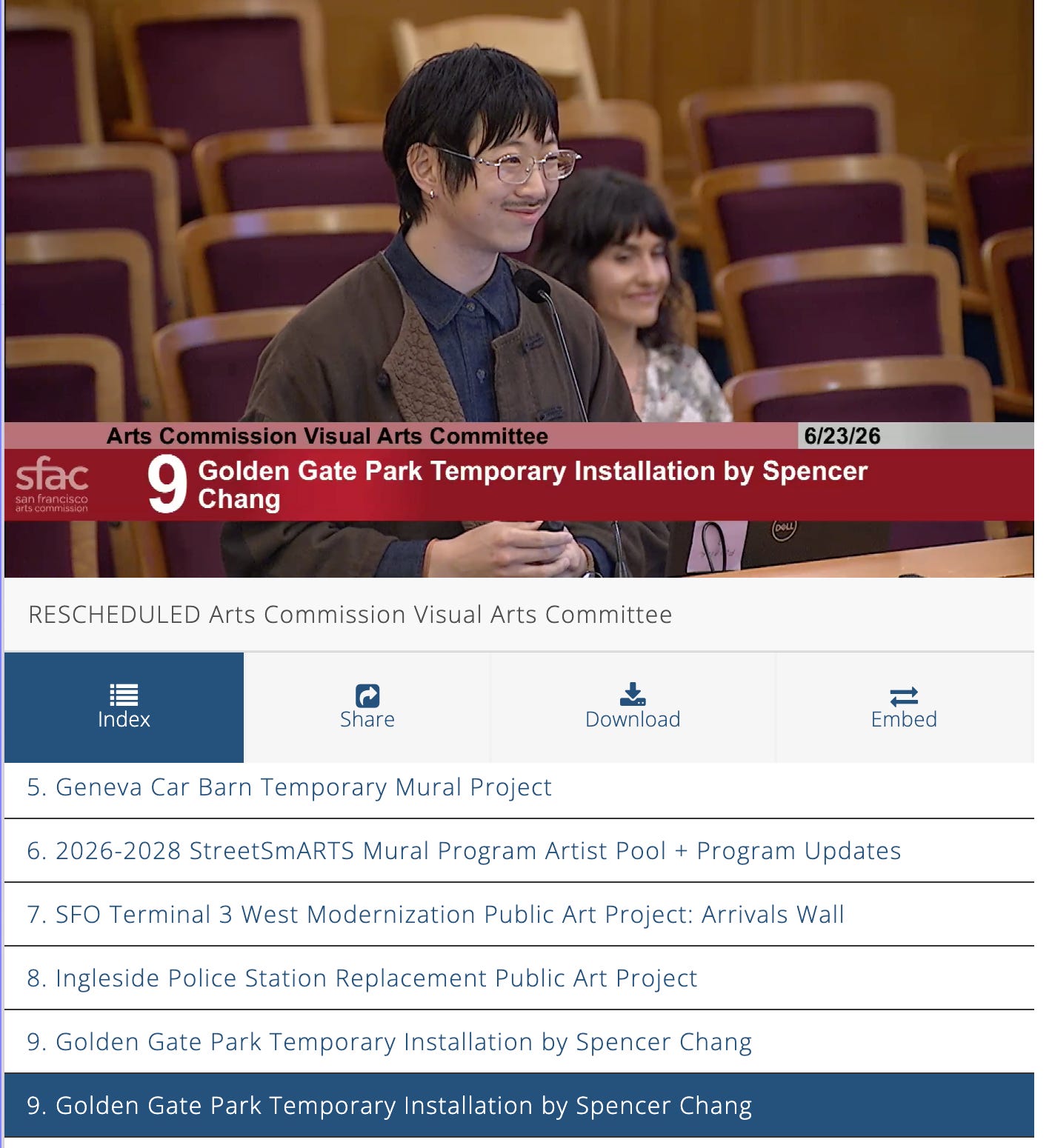
My first public art installation, Shrine to Earth (Pillars), has been approved by the San Francisco Arts Commission and will be coming to Golden Gate Park this fall for a year! Stay tuned
My class, Building Benches for the Web, with Munus Shih for SFPC is underway and we’ve already seen so many cool imaginations of social spaces. Excited to share these with the world!
I’ll be speaking about some of these things as it relates to my theory of change and practice at FWB Fest! The organizers have kindly provided me with some free tickets for my community. check out using this link with code FWBPLUS1
This dispatch was sent to 2574 inboxes. My writing is always free and open, but I am independently funded and appreciate any support you can offer. Consider sharing this with a friend and becoming a patron (or for those without Github, subscribing on Substack) for the warm & fuzzy feeling of supporting an indie artist (and access to the community & works-in-progress).
Thank you to the 28 people who supported my independent work with a sponsorship last month, and a warm welcome to Ross and Nada.
to more whimsy! 👐
here via xh/mmm. thanks for your work!