

In December and January, I spent over a month in China, across Shanghai, Jingdezhen (the ceramics capital), and Shenzhen (the manufacturing capital). I visited factories and studios, art museums and phone farms, and tiny stalls and bougie stores. I haven’t been in China since 2008, so everything was new and exciting to me.
What follows is a condensed breakdown of all the observations I had (of which there are a lot because China just operates so differently compared to every other country I’ve been to). I’m splitting them up into 3 sections: physical culture, digital culture, and craft/creative culture.
This is part three: creative & social culture.
“My livelihood is not your hobby,” said the Chinese ceramics master to our friend seeking to apprentice.
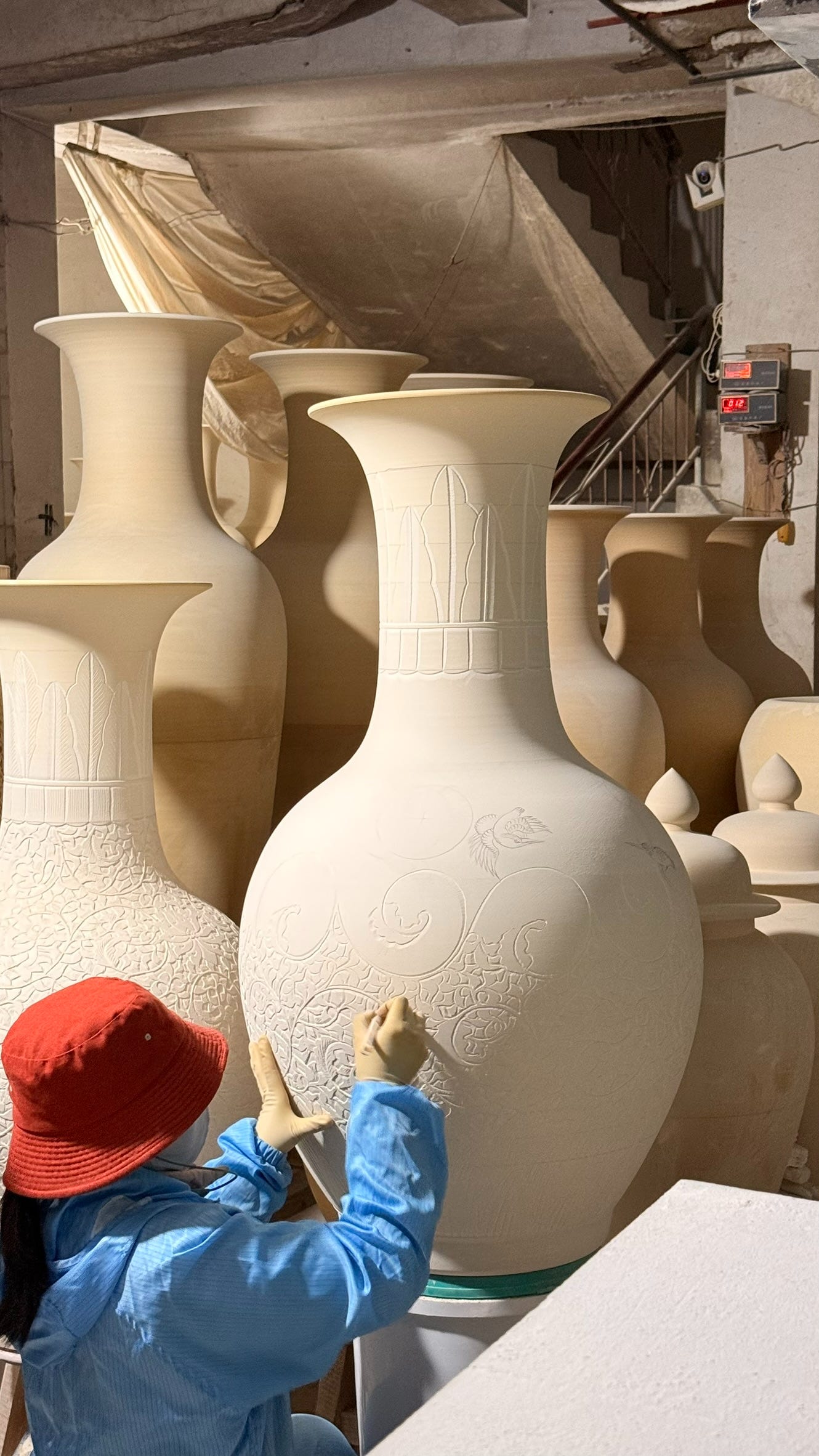
We were in 景德鎮 (Jingdezhen), the birthplace of porcelain. Down a street where the air was thick with dust, storefronts featured plates, cups, and vases of every size. Even some of the public trash cans and street laps were made of porcelain.
Our local tour guide (a friend who had moved there recently), pointed out the smaller stores hosting individual masters. One created molds, another painted beautiful figures, a third carved out intricate designs. Each chose a different thing to master. Rather than approaching the practice holistically, the industry operated best when you were just a piece of a larger ecosystem.
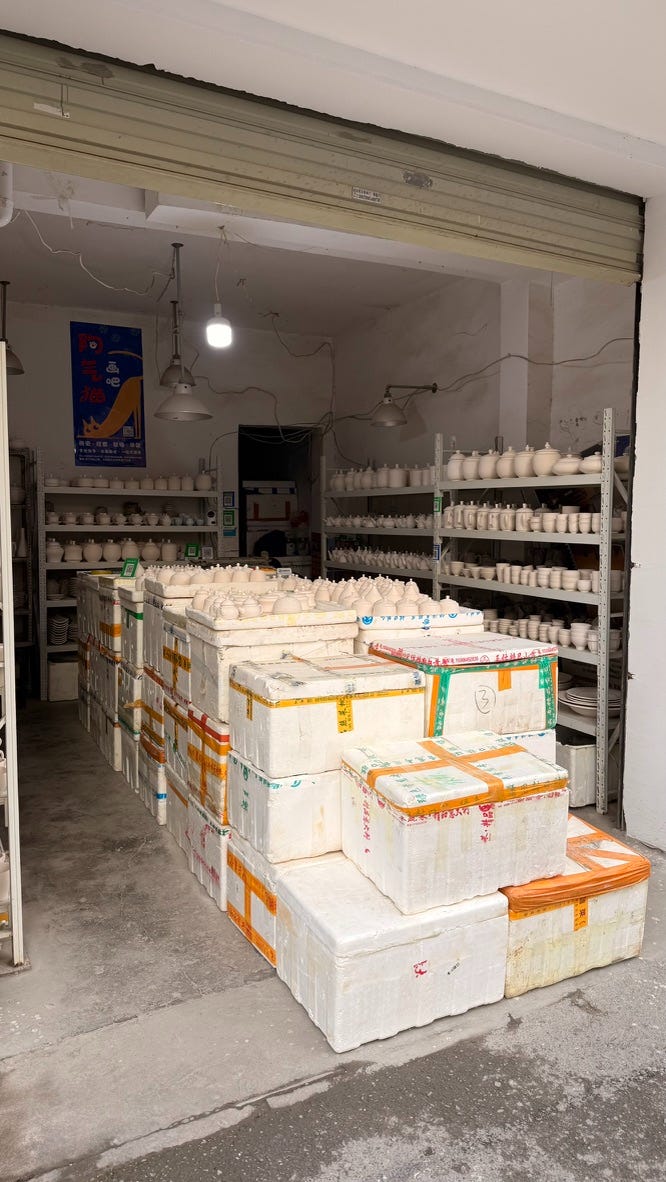
I didn’t understand the strong reaction at the time, but I started to piece together later. Asking to apprentice was a very normal American approach, but here, it violated a sacred norm. We hadn’t earned the right to ask; in fact, we had just shown our hand as clueless Americans.
In a factory in Shenzhen, I watched workers shepherd thousands of electronics and plastics through the assembly line, touching objects that would go on to be a part of the lives of millions of people every week.
The scale is baffling to try to comprehend, as was the theme of the experience in cities.
Before I visited, I thought factories would feel different from crafts like pottery and art, but I found them surprisingly similar. There’s more specialized processes, skills, and imperfections involved in the latter, but the industry treats them as the same. And despite the number of machines involved in the former, both wouldn’t survive without the massive amounts of manual human labor involved.
I think about the difference between the products I find here that feel more human-made (a cup thrown on a wheel) compared vs more machine-made (a plate made from a mold). There’s so many things I see online that I used to dismiss as cheap mass-produced objects, but I was realizing that many of them might actually be made mostly by hand.
There are “masters” in the factories just as there are in Jingdezhen. You must dance their game to earn their respect, and thus, their capacity for making your creation a reality for millions.
Over the course of a 2-hour drive out of Shenzhen, across a huge highway across an open sea, I watched massive skyscrapers shrink slightly and age dramatically. We had arrived in a Tier 2 city.
We walked into a hotel lobby which connected to a cavernous, mostly-abandoned mall. In the middle, a giant, taped off escalator flowed down into an empty bottom floor.
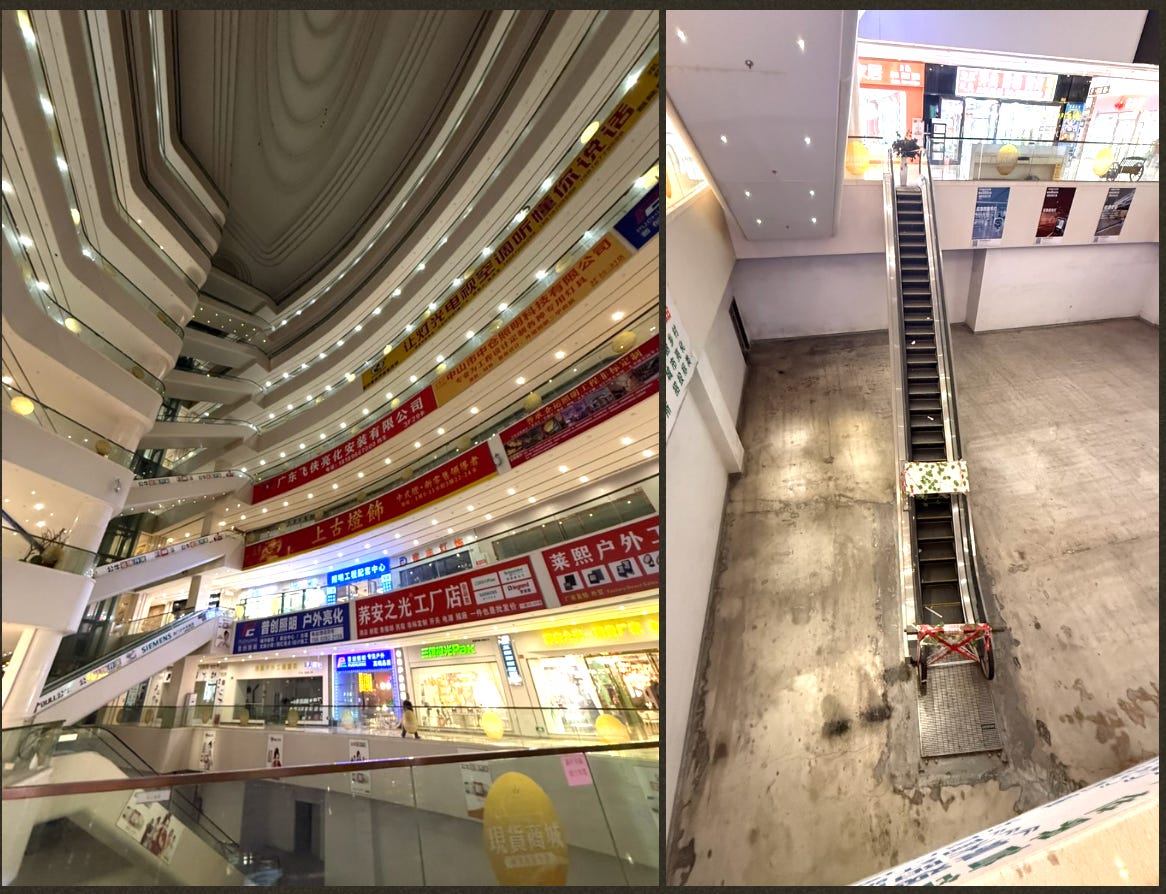
Upstairs, we met a stocky man who served us tea and fruits before he showed us the operation room. It was a normal office room but instead of monitors, hundreds of phones were strung up in staggering rows, all playing TikTok Lives. This “phone farm” sold new TikTok accounts on a sliding scale for the number of followers. These days they were experimenting with AI-generated content to grow new accounts. One test group of phones posted a diverse cast of AI American soldiers talking about home from a military base, others focused on AI Jesus content, and some tried variations of AI women in various outfits.
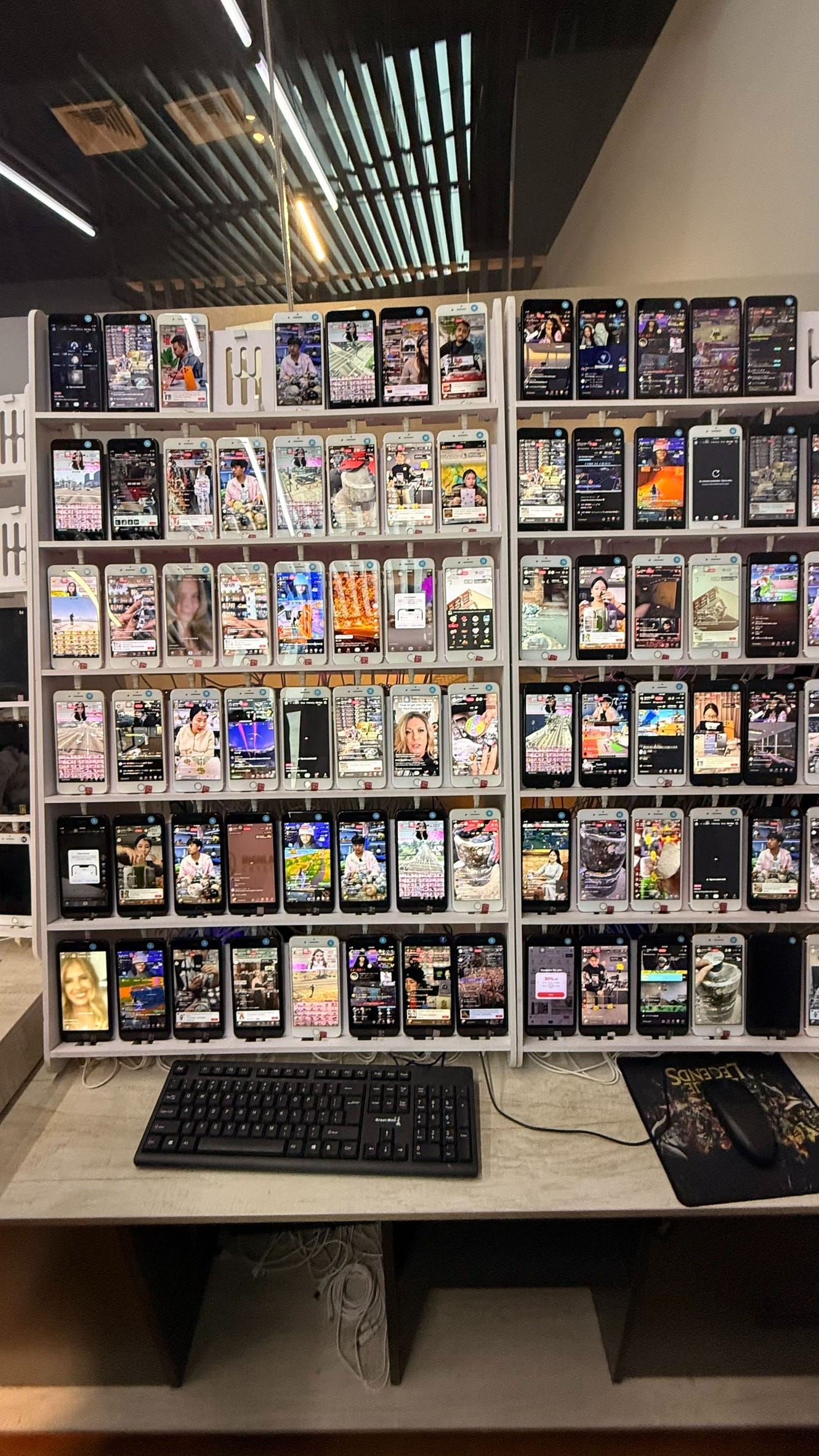
We talked about Intentions and history of the strategy of the business, and it became clear that there was no specific political strategy other than making a good business. They weren’t beholden to AI content (they were also experimenting with daily Tarot card readings and skyline timelapses), but AI content generation was the new cheap and efficient tool for them to try new things to fuel better growth.[1]
There was no malice, just a hunger for arbitrage.
One successful Chinese businessman remarked how competition is so fierce that “[product] innovation is a matter of survival.”
In Western society, ideas are everything. We idolize and promote Idea Guys who want to change the world and protect those inventions with copyright law.
In China, ideas are worthless; execution is the only thing that matters. The one who survives is the winner.
In Apple in China[2], Patrick Mcgee writes about a canon event in Apple shifting manufacturing to China when a Chinese supplier (Foxconn) won Apple’s favor by showing off a completely working iPod they had reverse-engineered without any assistance. There’s even a special term to describe this copying culture, Shanzai (山寨).[3]
If your idea is out there in the world, it can be reproduced.
In China, density of talent and availability of hands makes physical reality feel almost as moldable as clay. You get the sense that that anything you can imagine can be made.
Culture, on the other hand, feels immovable. To gain power, you have to play by ancient norms with new modern rules.
Gaining respect involves demonstrating positional awareness—knowing where you stand in the environment: socially, politically, culturally, etc.
Finding arbitrage is one way to show that you understand the meta. So people start businesses, devote their lives to a craft, and have no time or respect for those who can’t show that they, too, understand how the world works.
The strong resistance to changing minds was surprising. Changing people’s minds feels like a natural given in Western culture. All my work deals with changing the status quo around computers and the internet, and so many of my peers and mentors are invested in changing culture. There may be arbitrage in the combination of these two...
I kept thinking of ocean waves, how peaceful and even simple they look from afar, and how ruthless they can be if you underestimate them. Like water, modern Chinese culture can be deceiving, and it expands, filling every crevice that it can. Any opportunity will be seized, any arbitrage will be leveraged. It’s not personal; it’s just in its nature.
This was my final dispatch from my trip in China! It took me a while to finish, but I’m still reflecting on many of these experiences and lessons.. I’d love to hear thoughts if you have had experiences or any other connections it makes you think of! Back to my regularly scheduled programming next - with a fun announcement coming in the next week :)
This dispatch was sent to 2274 inboxes. My writing is always free and open, but I am independently funded and appreciate any support you can offer. Consider sharing this with a friend and becoming a patron (or for those without Github, subscribing on Substack) for the warm & fuzzy feeling of supporting an indie artist (and access to the community & works-in-progress).
Thank you to the 30 people who supported my independent work with a sponsorship last month, and a warm welcome to Mara, Tyrone, and Kendall.